
- What Is Minecraft PlayBattleSquare?
- How Does Minecraft PlayBattleSquare Work?
- Minecraft PlayBattleSquare Game Modes
- How to Play Minecraft PlayBattleSquare
- Best Minecraft PlayBattleSquare Strategies
- Servers, Maps, and Battle Arena Setup
- Is Minecraft PlayBattleSquare Worth Playing?
- Frequently Asked Questions
The easiest way to understand Minecraft PlayBattleSquare is as a term connected with Minecraft gaming content and, in some online descriptions, competitive PvP arena gameplay. The basic idea often presented is simple: players enter a limited battle area and rely on movement, timing, equipment, positioning, and combat skills to defeat opponents. That makes the concept feel quite different from an ordinary Survival world, where gathering materials, building shelters, mining, farming, and exploration can take up most of a player’s time.
However, players should know that there is no standard official Minecraft mode from Mojang called PlayBattleSquare. Online descriptions can mix the PlayBattleSquare gaming website or brand with community-created Minecraft battle ideas. Therefore, exact rules, maps, kits, player counts, and objectives can vary depending on where someone encounters the name. It is better to think of the term as connected with Minecraft battle content rather than assume every mention refers to one identical game, plugin, or official server.
| Detail | Quick Information |
|---|---|
| Name | Minecraft PlayBattleSquare |
| Connected With | Minecraft gaming and PvP content |
| Official Mojang Mode? | No |
| Typical Gameplay Described Online | Arena-style player battles |
| Main Skills | Movement, timing, PvP and positioning |
| Possible Format | Solo, teams or custom community battles |
| Fixed Official Rules? | No |
| Best For | Players interested in competitive Minecraft |
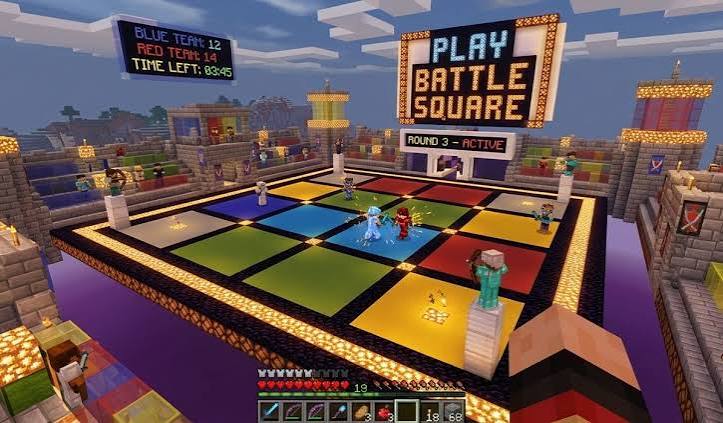
One reason the keyword can be confusing is that Minecraft is extremely customizable. Server owners and map creators can build battle arenas with their own rules. One arena might give every player the same sword and armor, while another could require players to collect equipment during a match. A creator could also build a square battlefield and develop rules around knockback, elimination, team fighting, or controlling particular parts of the map.
This freedom means a PlayBattleSquare-style match does not need to copy one exact formula. The most useful idea for beginners is to focus on the competitive battle concept behind the term. Instead of spending hours developing a Survival world, players can enter a controlled environment where decisions happen quickly and combat ability matters much more.
Is Minecraft PlayBattleSquare an Official Minecraft Mode?
No. Players should not place Minecraft PlayBattleSquare beside Survival, Creative, Adventure, Spectator, or Hardcore as though Mojang added it as another standard Minecraft mode. Those established modes are part of Minecraft itself, while PlayBattleSquare descriptions found online are associated with gaming content and community-style battle concepts.
This difference matters because unofficial Minecraft experiences can change greatly from one server or community to another. If a website promises a particular PlayBattleSquare server, downloadable map, mod, or plugin, players should check exactly what is being offered before installing anything. Recognizing the difference between official Minecraft features and community-created content makes it easier to understand what PlayBattleSquare can—and cannot—mean.How Does Minecraft PlayBattleSquare Work?
The basic idea behind Minecraft PlayBattleSquare is competitive Minecraft combat inside a controlled space. Instead of spending most of the session mining or building, players focus on fighting, movement, positioning, and staying alive. However, there is no single official PlayBattleSquare rulebook, so the exact experience can change depending on the server, map, or community using the concept.
A battle may start with players appearing at separate spawn points. They could receive equal equipment or collect useful items around the arena. From there, success depends on how well each player uses Minecraft’s combat mechanics. A skilled player does not simply attack constantly. They watch their surroundings, judge distance, manage health, and choose the right moment to fight.
Basic Gameplay and Battle Concept
Arena-style Minecraft combat usually keeps players closer together than normal Survival gameplay. This creates faster encounters because opponents cannot simply travel thousands of blocks away. Walls, platforms, obstacles, corners, and changes in height can make a small battlefield surprisingly tactical.
Players also need to understand the rules of the particular match they join. Some community arenas may use elimination rules, while others could use points, lives, rounds, or team objectives. Because PlayBattleSquare is not a standardized Mojang mode, readers should check the rules provided by the specific server or map rather than expecting every version to work identically.
An Interesting Minecraft Combat Fact
Minecraft combat has changed considerably during the game’s history. In Java Edition, modern combat includes an attack cooldown system. Waiting for an attack to recharge can make a hit more effective, which means repeatedly clicking as quickly as possible is not always the best strategy.
This makes timing valuable in competitive play. Players who understand weapon reach, shields, knockback, critical hits, movement, and attack timing can often perform better than someone who simply rushes toward every opponent.
Interesting fact: A small Minecraft arena can require more awareness than a huge open area because players have less space to escape mistakes.
Minecraft PlayBattleSquare Game Modes
Because PlayBattleSquare is not an official standardized Minecraft mode, there is no confirmed universal list of PlayBattleSquare game types. Community creators can build different battle formats around an arena concept. Free-for-all is one possibility, where everyone competes independently and the last surviving player or highest scorer wins.
Team battles offer another natural format. Players can divide into groups and work together rather than relying entirely on individual combat skill. Custom maps can also introduce objectives, limited lives, item collection, control points, or shrinking playable areas. These variations come from Minecraft’s wider custom-map and multiplayer culture rather than one official PlayBattleSquare specification.
Free-for-All Battles
Free-for-all combat creates constant pressure because every other player can become an enemy. There may be no teammate available to protect someone who gets trapped in a difficult position. Players therefore need to watch several directions and avoid entering fights without considering who else is nearby.
Patience can become surprisingly useful. Defeating one opponent may leave a player low on health, allowing another person to attack immediately afterward. Choosing when not to fight can sometimes be as important as landing a successful attack.
Team-Based Battles
Team battles add communication and cooperation to Minecraft PvP. One player can apply pressure while another watches an escape route. Teams can also share information about enemy positions and decide which opponents represent the greatest threat.
Poor coordination can quickly create problems. If every teammate runs in a different direction, opponents may isolate them one at a time. Staying close enough to help each other, without standing so close that everyone becomes an easy target, creates a useful balance.
How to Play Minecraft PlayBattleSquare
There is no universal PlayBattleSquare button inside the standard Minecraft menu. Players looking for this experience should first identify whether the term they found refers to a particular website, server, custom map, minigame, or simply an article describing arena PvP. This simple check can prevent confusion.
For community multiplayer battles, players generally need the correct Minecraft edition and game version required by the server. Private battles are another option. Friends can build an arena themselves, create spawn areas, agree on equipment and rules, and then compete without needing an experience officially named PlayBattleSquare.
| Stage | What the Player Should Do |
|---|---|
| 1. Check the source | Find out what “PlayBattleSquare” refers to |
| 2. Read the rules | Understand the battle objective |
| 3. Prepare equipment | Learn what weapons and items are allowed |
| 4. Study the arena | Notice cover, corners and dangerous areas |
| 5. Watch opponents | Follow movement before attacking |
| 6. Choose fights carefully | Avoid unnecessary damage |
| 7. Adapt | Change tactics when opponents change theirs |
Java and Bedrock Differences
Players should not automatically assume that a multiplayer experience works on both Java Edition and Bedrock Edition. Servers, commands, combat mechanics, and supported features can differ between the two editions. A server created specifically for Java players may not accept a normal Bedrock connection unless additional compatibility systems have been configured.
Combat also feels different across editions and versions. Therefore, a strategy learned from one Minecraft environment may require adjustment somewhere else. Checking compatibility before joining saves time and avoids unnecessary installation attempts.
Best Minecraft PlayBattleSquare Strategies
Strong Minecraft PvP starts with movement and awareness. Running directly toward every enemy makes a player’s intentions easy to predict. Better players watch their opponent’s direction, maintain useful distance, and look for moments when an enemy is distracted or badly positioned.
Positioning becomes even more important inside a small arena. Standing near an exposed edge can make knockback dangerous, while getting trapped in a corner removes escape options. Players should constantly ask themselves where they can move if the next attack goes badly.
Improve Movement and Timing
Moving unpredictably can make attacks harder for opponents to land. Strafing, changing direction, sprinting at useful moments, and using terrain can all affect an encounter. Movement should still have a purpose; random jumping or running can make the player easier to read and may waste opportunities.
Attack timing matters as well, particularly under Java Edition’s cooldown-based combat. Players should learn the mechanics of the Minecraft version they are actually playing rather than copying every technique shown in older PvP videos.
Manage Health and Resources
A player who wins a fight with almost no health remaining can immediately become an easy target. This is why resource management matters in multi-player battles. Food, healing items, armor durability, arrows, shields, or other allowed resources should be treated as limited tools rather than wasted without thought.
Knowing when to retreat is another skill. Moving away from a bad fight does not necessarily mean playing poorly. A short retreat can provide time to recover, reposition, or force an aggressive opponent into a less favorable area.
Common Mistakes to Avoid
New players often focus entirely on the opponent directly in front of them. In a battle involving several people, that creates tunnel vision. Someone else may approach from behind while the player is concentrating on a single fight.
Another common mistake is attacking without understanding the map. Learning escape paths, high ground, obstacles, and exposed edges before fighting can provide a meaningful advantage.
Minecraft PlayBattleSquare Servers, Maps, and Arena Setup
Players do not need an enormous world to create an enjoyable battle arena. A relatively compact space can work well when it provides several movement options. The important part is creating a battlefield that feels fair while still encouraging players to make tactical decisions.
A completely empty square may become repetitive. Builders can add walls, pillars, stairs, platforms, narrow passages, and open areas. These structures create decisions about cover and movement. Care is still necessary because too many obstacles can make players hide rather than fight.
Building a PlayBattleSquare-Style Arena
Start by choosing the approximate player count. An arena designed for four players will usually feel very different when twenty people enter it. Spawn points should be separated fairly so one player does not begin with an immediate advantage.
After creating the basic shape, builders can test the arena through several matches. Testing often reveals problems that are difficult to notice while building. One position may provide too much protection, a spawn point may be exposed, or a raised platform may dominate the entire battlefield.
Useful arena elements can include:
- Balanced spawn locations
- Several movement routes
- Limited cover
- Open fighting areas
- Clearly marked boundaries
- Safe spectator areas
- Fair access to important resources
The goal is not to fill every block with decoration. Good competitive design gives players meaningful choices while preventing one position from becoming overwhelmingly powerful.
Keeping Battles Fair
Fairness is essential for enjoyable PvP. Giving one player stronger equipment without a rule-based reason creates an obvious advantage. Starting kits should therefore be balanced when the goal is a skill-focused match.
Server administrators also need clear rules concerning cheating, exploits, abusive behavior, and unauthorized modifications. Competitive Minecraft becomes more enjoyable when everyone understands what is allowed before a match begins.
Is Minecraft PlayBattleSquare Worth Playing?
For players who enjoy fast Minecraft combat, a PlayBattleSquare-style battle concept can be entertaining. Smaller arenas create frequent encounters and encourage players to improve skills such as positioning, movement, timing, and quick decision-making. Friends can also change the rules easily, giving the same arena several different uses.
Players who mainly enjoy peaceful building, exploration, farming, or long Survival adventures may find arena combat less appealing. Minecraft’s strength is that these experiences do not need to replace each other. A player can spend one day building a Survival base and another practicing PvP with friends.
PlayBattleSquare vs Traditional Minecraft Survival
Traditional Survival is much broader. Players gather resources, craft tools, explore caves, fight mobs, build structures, farm, and eventually take on larger challenges. Progress can continue for hundreds of hours in the same world.
Arena PvP is more focused. The objective is normally tied to the immediate match rather than developing a permanent world. This makes battle arenas useful when players want shorter competitive sessions instead of a long Survival project.
PlayBattleSquare vs Survival Games
Survival Games-style experiences generally combine exploration, item collection, and player elimination across a larger map. Players often spend part of the match searching for equipment before encountering enemies.
A small square-arena concept can bring opponents together much sooner. Less time may be spent searching and more time fighting. However, the exact comparison depends entirely on the custom rules used by the map or server.
Interesting Facts About Minecraft Battle Gameplay
Minecraft was not originally built only around competitive multiplayer. Its flexible blocks, commands, servers, Redstone systems, maps, and community tools eventually allowed creators to build many types of minigames.
This flexibility is one reason terms such as PlayBattleSquare can appear online even when they are not official Mojang modes. Minecraft communities regularly turn the game’s basic mechanics into completely different experiences.
Did you know? A Minecraft PvP arena can be built without changing the core idea of Minecraft itself. Builders use ordinary blocks and game mechanics to create rules and environments that feel like separate minigames.
That creative freedom is an important part of Minecraft’s lasting popularity. The same game can support peaceful builders, Survival explorers, technical Redstone players, speedrunners, and competitive PvP communities.
Frequently Asked Questions
What is Minecraft PlayBattleSquare?
Minecraft PlayBattleSquare is a term found online around Minecraft gaming content and arena-style PvP descriptions. It should not be treated as an official Mojang game mode. Depending on the source, it may refer to PlayBattleSquare content or a community-style battle concept.
Is Minecraft PlayBattleSquare an official Minecraft mode?
No. Mojang does not list PlayBattleSquare as one of Minecraft’s standard game modes. Players should check the specific website, server, or map where they encountered the name to understand what it means there.
Can beginners play PlayBattleSquare-style battles?
Yes. Arena battles can help beginners practice movement, positioning, attack timing, and awareness. Starting with friends or balanced beginner matches can make learning easier.
Can you play Minecraft PlayBattleSquare with friends?
Friends can create their own PlayBattleSquare-style experience by building an arena and agreeing on rules, equipment, teams, and victory conditions. A special official mode is not required to create a simple PvP battle.
Does Minecraft PlayBattleSquare require mods?
Not necessarily. Basic PvP arenas can be created with normal Minecraft blocks and multiplayer features. More advanced servers may use plugins, commands, datapacks, or other custom systems, depending on the experience they want to provide.
Final Thoughts
Minecraft PlayBattleSquare is best understood carefully rather than treated as an official Minecraft product. The name appears around gaming content and descriptions of competitive Minecraft battles, but there is no single Mojang-standard PlayBattleSquare mode with universal rules.
For players, the interesting part is the arena concept itself. Small battlefields can turn familiar Minecraft mechanics into quick tests of movement, timing, awareness, and strategy. Whether players use an existing community map or build a square arena with friends, the freedom to create new ways to play remains one of Minecraft’s biggest strengths.
Read more :Kara Leigh Dimon: The Private Life Behind a Famous Banking Family